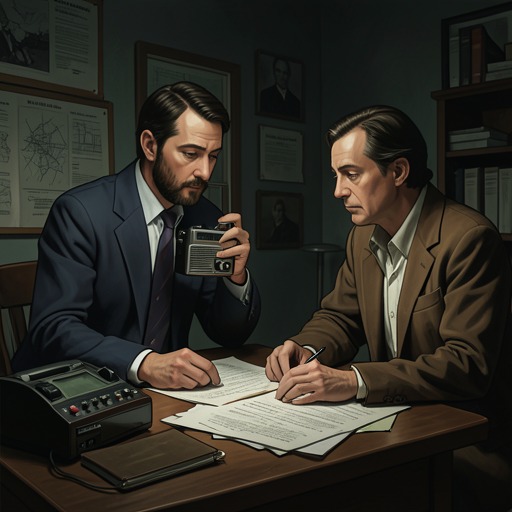
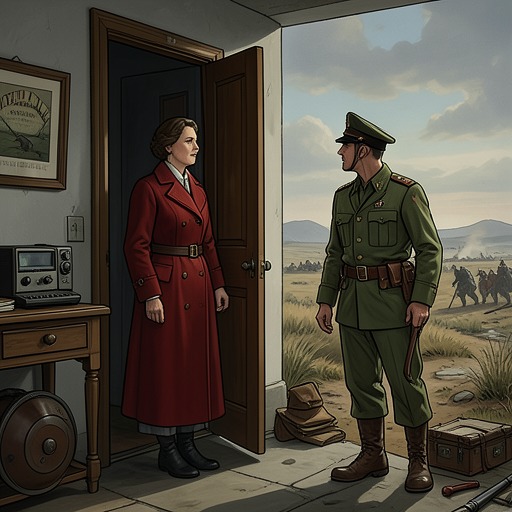
Werner and Volkheimer blast their way out of the rubble
All the Light We Cannot SeeThe escape of Werner Pfennig and Frank Volkheimer from beneath the ruined Hotel of Bees is a chain of small, practical decisions made in a sealed space where neither can see a way out. A radio left with a dying battery unexpectedly receives music; Volkheimer recognizes the possibility of acting, and Werner turns the radio’s power into light. A grenade shifts the rubble, after which Volkheimer opens a passage and pulls Werner out. The scene moves from near-stillness to coordinated effort, and from darkness underground to a view of the devastated city under starlight.
The buried men
The episode begins within a sleeping city. Gunners, nuns in a crypt beneath the cathedral, children and mothers in cellars, a doctor in the basement of the Hôtel-Dieu, wounded Germans in tunnels beneath La Cité stronghold, and Etienne behind the walls of Fort National are all described as asleep. The list places individual hiding places within a citywide pause: beneath the surface, people seek shelter while snails and rats continue to move among the rocks and rubble. Werner, too, sleeps in a hole under the ruins of the Hotel of Bees.
Volkheimer alone remains awake. He sits with the large radio in his lap and the battery between his feet. Static whispers through the headphones Werner left for him. He does not expect to hear a message; he keeps the headphones on because they are where Werner put them, and because he cannot bring himself to remove them. He has also convinced himself that moving will bring down the plaster heads across the cellar. These details establish the immediate obstacles to escape: the men are buried, the equipment is failing, and Volkheimer’s fear and exhaustion have reduced his activity to waiting.
Music becomes a signal
Against that expectation, the static resolves into music. The change is first presented as something almost impossible, but it gives Volkheimer a reason to stand and act. He finds Werner in the darkness and puts the headphones on him, urging him to listen. Werner recognizes the piece as Clair de Lune. The music does not itself provide an exit, but it marks the instant when the radio ceases to be merely a dead weight or a source of static. Its unexpected reception reconnects the men to a world beyond the cellar and prompts the next instruction.
Volkheimer tells Werner to connect the light to the battery. Werner asks why, but follows the order. Before the song ends, he disconnects the radio from the battery, unscrews the bezel and bulb from the field light, and touches them to the electrical leads. The improvised connection gives them a sphere of light. The scene makes their escape depend not on a rescue arriving from outside but on Werner’s technical skill and on the parts already at hand: battery, radio leads, and a field-light bulb. Listening leads to a command; the command becomes a working light.
Opening a route through the rubble
With Werner able to see, Volkheimer begins clearing the cellar’s back corner. He moves blocks of masonry, timber, and shattered wall sections, then stacks them into a barrier. That barrier is a deliberate precaution, not an exit: Volkheimer pulls Werner behind it before preparing a grenade. He unscrews its base and pulls the cord to start the five-second fuse, while Werner covers his helmet with one hand. Volkheimer throws the grenade toward the place where the stairwell used to be.
The explosion briefly leaves Werner unable to breathe and collapses the makeshift barrier, while debris moves through the darkness. Yet the detonation also shifts the building’s rubble. A snap and several cascades follow; when Werner can push debris off his chest, he sees Volkheimer looking toward a single opening of purple light. The blast has not cleared a ready-made passage. Rather, it has altered the obstruction enough to expose a narrow breach, changing the men’s task from surviving under the cellar’s ceiling to enlarging a route upward.
Volkheimer climbs partway up the ruined staircase and strikes the hole’s edges with a piece of rebar. Werner watches the opening widen from a sliver to a wedge wider than his hands. Volkheimer continues until a large slab breaks apart. Only then can they scramble and climb through. Volkheimer squeezes his upper body through first, then reaches back for Werner, his canvas duffel, and the rifle. The rescue is physical and mutual in its essentials: Volkheimer makes the opening and hauls the others through, while Werner has supplied the light and follows him out.
The city above
They emerge onto what had once been an alley and kneel beneath the open night sky. Werner sees no moon. Volkheimer turns his palms upward, a gesture that follows their passage from a confined, dark cellar into open air. The action has stopped, but the men are not yet shown as restored or safe: they stagger as they make for the sheltered side of the ramparts.
The ruins around them establish the scale of what they have survived. Only two walls of the Hotel of Bees remain joined at a corner, with houses beyond displaying their interiors to the night. The rampart still stands, although many of its upper embrasures have been shattered; the sea is audible beyond it. The narrative counts nine bodies in the rubble, then allows that there may be more. Their emergence therefore brings no simple return to an intact world. It places Werner and Volkheimer among the aftermath of destruction, with the city’s broken buildings and the dead still surrounding them.
The episode’s decisive reversal is built from limited resources rather than a sudden rescue: static becomes music, the battery powers a light, and the grenade’s blast shifts the rubble enough for Volkheimer to make an opening. Each step depends on the previous one, and each changes what the men can do. The shift from the sleeping city below to the exposed ruins above also widens the scene’s focus: the escape frees two living men, while making visible the devastation and the human cost around them.